Goals
- Replacement of the obsolete Lenze 9300-EI servo drives, which are difficult to source and becoming increasingly expensive.
- To ensure the long-term supply of spare parts and the reliable operation of the equipment.
- Retaining the existing mechanical components, motors, sensors and cabling wherever possible.
- To achieve a control response time that is the same as, or better than, that of the previous system.
- Development of a state-of-the-art industrial communication and motion control architecture.
- Upgrading machine safety functions to meet modern drive technology requirements.
Challenges
- The three Lenze 9300-EI servo drives used in the automatic tile-cutting machine performed not only drive control functions but also integrated PLC functions. The coordinated operation of the three units was achieved via several communication interfaces.
- Support for multiple communication protocols: the drives were connected to the central Siemens S7-300 PLC via PROFIBUS, whilst they communicated with one another via the CAN bus and via DFIN/DFOUT interfaces transmitting analogue synchronisation signals.
- One of the system’s most important technical requirements was to maintain fast and accurate synchronised operation. The controls integrated into the existing drives operated with a cycle time of 2–3 ms; therefore, when designing the new system, it was necessary to ensure that the coordination of the drives and the control of the cutting process took place with a response time at least equal to that of the original system.
- A further challenge was that the modernisation had to be carried out with as little mechanical and electrical intervention as possible. Retaining the existing motors, sensors, terrain transmitters, cabling and pneumatic system was a key consideration.
Solution
- The obsolete Lenze 9300-EI drives have been replaced with state-of-the-art Lenze i950 servo drives.
- The motion control tasks were carried out by a central Lenze c520 motion controller.
Results
- We replaced the Lenze 9300-EI drives with state-of-the-art i950 servo drives, thereby successfully completing the retrofit project.
- The new, state-of-the-art communication architecture based on EtherCAT and PROFINET ensures simpler and faster data exchange.
- Achieving a control cycle time of 1 ms, which is faster than before.
- The dual-channel STO function has made it possible to implement an enhanced machine safety system and a more advanced drive enable and disable structure.
- Ensuring the long-term supply of spare parts.
State-of-the-art drive technology and central motion control
The following components form the new basis of the system:
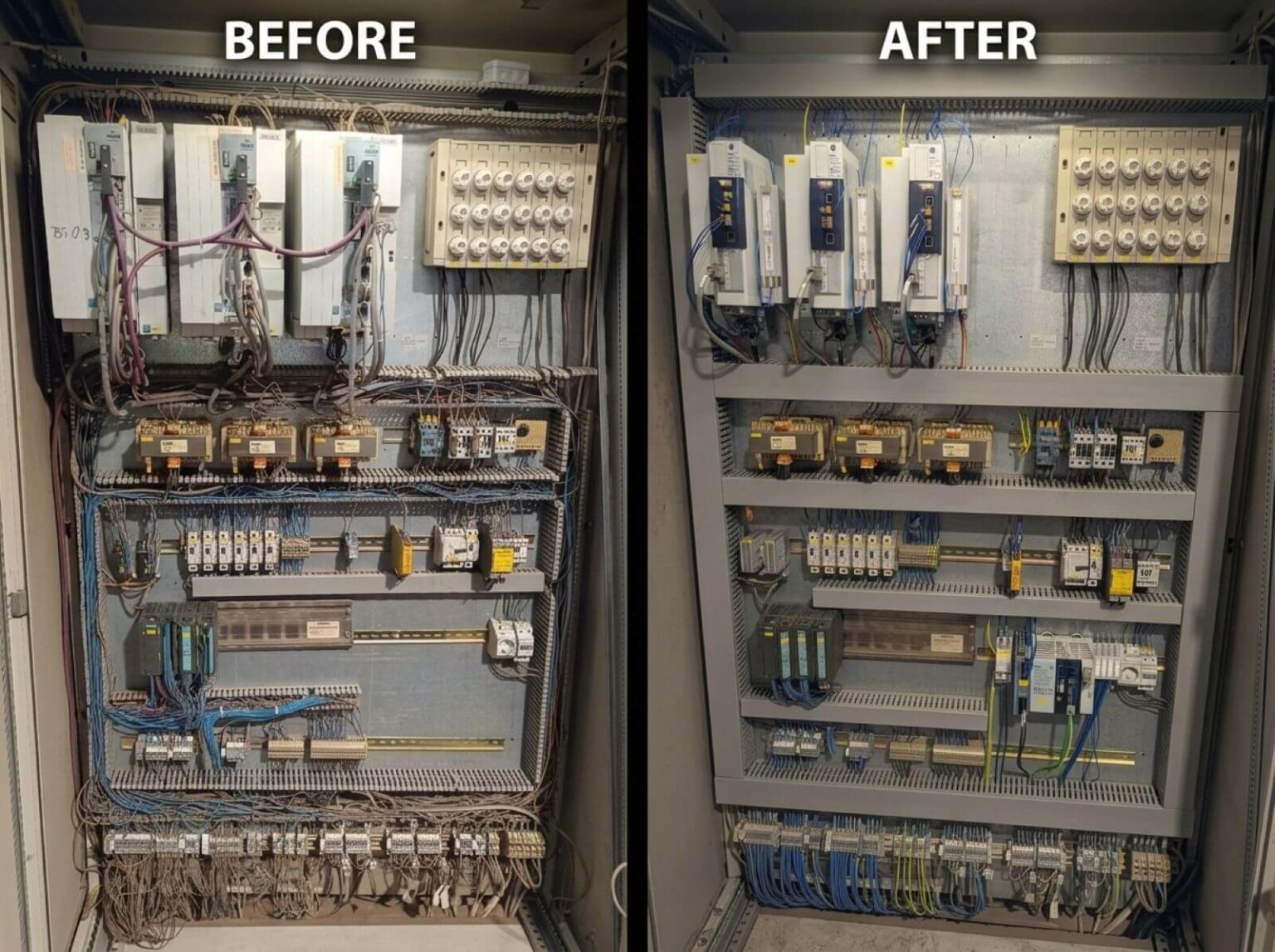
- 3 Lenze i950 drive controllers.
- 1 Lenze c520 motion controller.
- Lenze I/O-System 1000 modules.
- Braking resistors designed to match the drives.
Although the i950 drives have their own PLC functions, the machine’s application-specific requirements are more complex than this. Relying solely on the drives’ own PLC functions would not have been sufficient to guarantee the 2–3 ms cycle time required by the previous drive-integrated control systems. We therefore opted to use a central motion controller, which reduces the control cycle time to 1 ms. This ensures fast, deterministic and coordinated motion control, whilst also making the programming and maintenance of the entire system more transparent.
A further advantage of the centralised architecture is that the control logic, which was previously distributed across several separate drives, can now be managed within a single project. The programming environment is based on the CODESYS-based technology already used in the Lenze 9300 series, ensuring that the development and maintenance processes remain standardised.
Modernisation of the communications architecture
We have replaced the previous PROFIBUS and CAN bus-based communication systems with more modern, high-speed industrial interfaces. We have established EtherCAT communication between the motion controller and the drives, which, with a cycle time of 1 ms, ensures the data exchange required for synchronised movements and high-speed cutting operations. The central motion controller is connected to the remaining Siemens S7-300 PLC via PROFINET, in I-Device configuration.
The external material speed and position sensor was connected directly to the motion controller’s high-speed counter input. This has made it possible to dispense with the previous analogue synchronisation signal transmission between drives (DFIN/DFOUT), thereby simplifying the system architecture and signal processing. The new communication architecture ensures a clearer system structure, rapid data exchange and more precise motion synchronisation.
Upgrading machine safety functions
Replacing the drives has also made it possible to utilise state-of-the-art, integrated safety functions. The Lenze i950 drives feature a Safe Torque Off (STO) function, which can be used up to safety level SIL 3 / PL e. In the new system, the existing Pilz PNOZ S3 safety relay enables the drives to operate via a two-channel connection.
We implemented the coordinated safety shutdown of the three drives using a solution known as Cascading STO (CAS), which ensures a uniform and synchronised shutdown. This has resulted in a more modern, dual-channel safety architecture, replacing the previous single-channel drive authorisation system.
Minimal interference with the existing system
One of the key considerations in the modernisation was to ensure that as many existing components as possible could be retained unchanged.
Accordingly, we retained the existing motors; no mechanical modifications were required, and the existing sensors and field transmitters remained in use. We retained the existing cabling and the pneumatic system remained unchanged. We integrated the state-of-the-art drive technology components we installed into the existing control cabinet.
This approach significantly reduced the scope of the work required for the modernisation, whilst allowing the equipment’s fundamental operating concept to remain unchanged.
Preserving the value of existing machinery through state-of-the-art technology
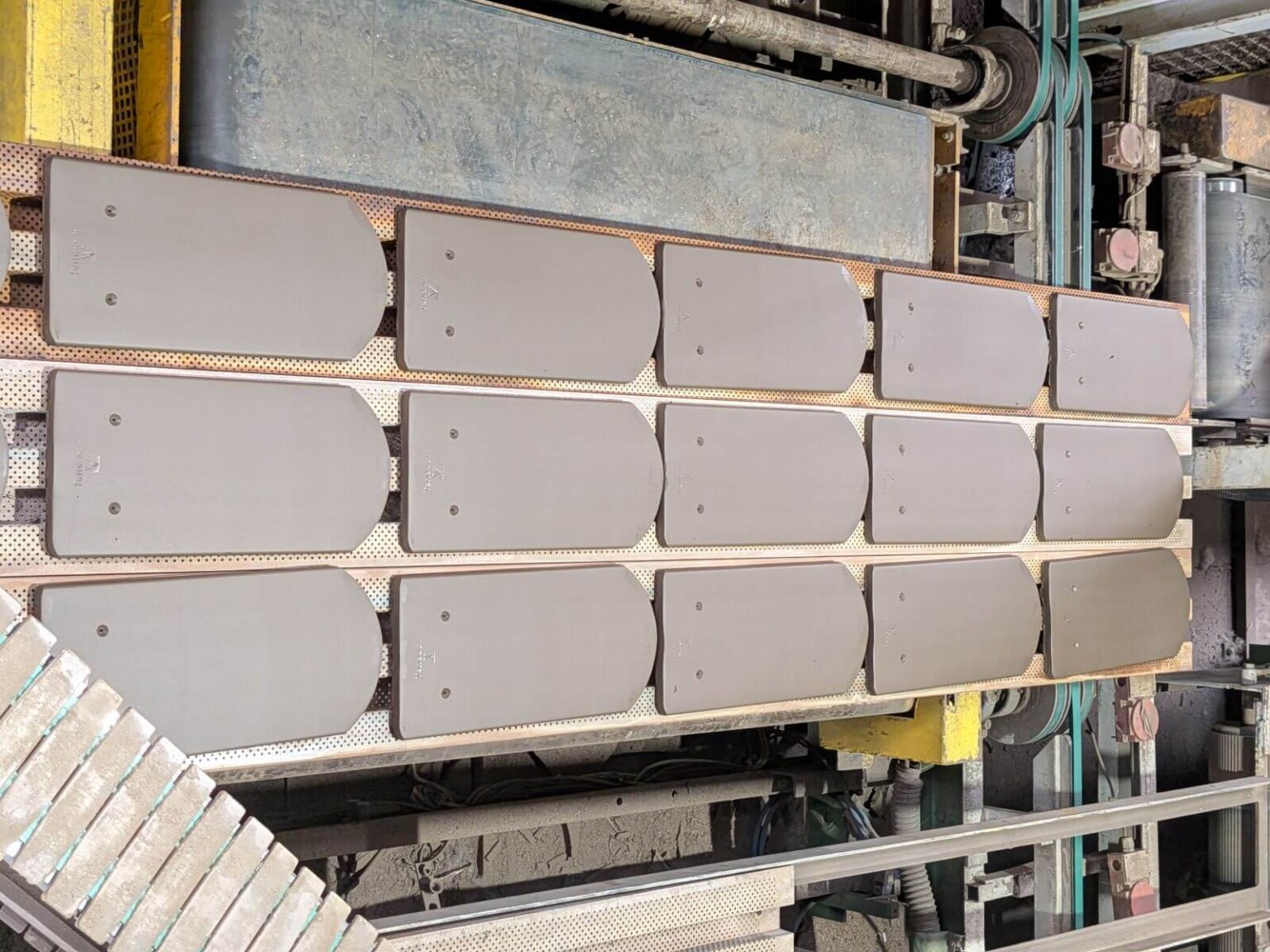
Following the successful commissioning of the the automatic tile-cutting machine was able to resume production with state-of-the-art Lenze drive technology and a motion control system.
This project is a good example of how significant technical progress can be achieved through targeted modernisation of drives and control systems, rather than completely replacing older industrial equipment. Through the use of Lenze i950 drives and the c520 motion controller, the automatic tile-cutting machine in Csorn has been given a modern, long-term sustainable technological foundation, whilst the existing mechanical structure and numerous components that were still in good working order could remain in use.
IDM-Systems carried out the complete electrical design and installation for the project, as well as the PLC and motion control programming and commissioning. This retrofit project demonstrates how the life cycle of existing industrial equipment can be extended through targeted, cost-effective improvements in automation and drive technology.
 Hungarian
 English
 German