Goals
- Detailed, realistic representation of manufacturing processes and production management logic.
- Automatic scanning and replay of daily production schedules.
- Validate the simulation with real performance data.
- Objective, rapid assessment and improvement of the quality of the schedule.
Challenges
- Accurate modelling of highly automated, complex manufacturing environments.
- Realistic replay and evaluation of scheduling scenarios.
- Provide fast, day-to-day decision support to production management.
Solution
- Siemens Plant Simulation based detailed factory model including machines, material handling, recipes and resources.
- Automatic schedule import and simulation run.
- Validation with real performance data to ensure reliability.
- Provide analytical outputs that give clear feedback on the effectiveness and weaknesses of the schedule.
Results
- The evaluation time for schedules has been reduced from hours to minutes.
- The risk of introducing incorrect or overloaded schedules has been eliminated entirely.
- Optimised schedules have reduced production lead times by up to 15%.
- Decision support for the scheduling process has become fully data-driven.
Challenge: Simulation of a complex factory, replay of a scheduling scenario
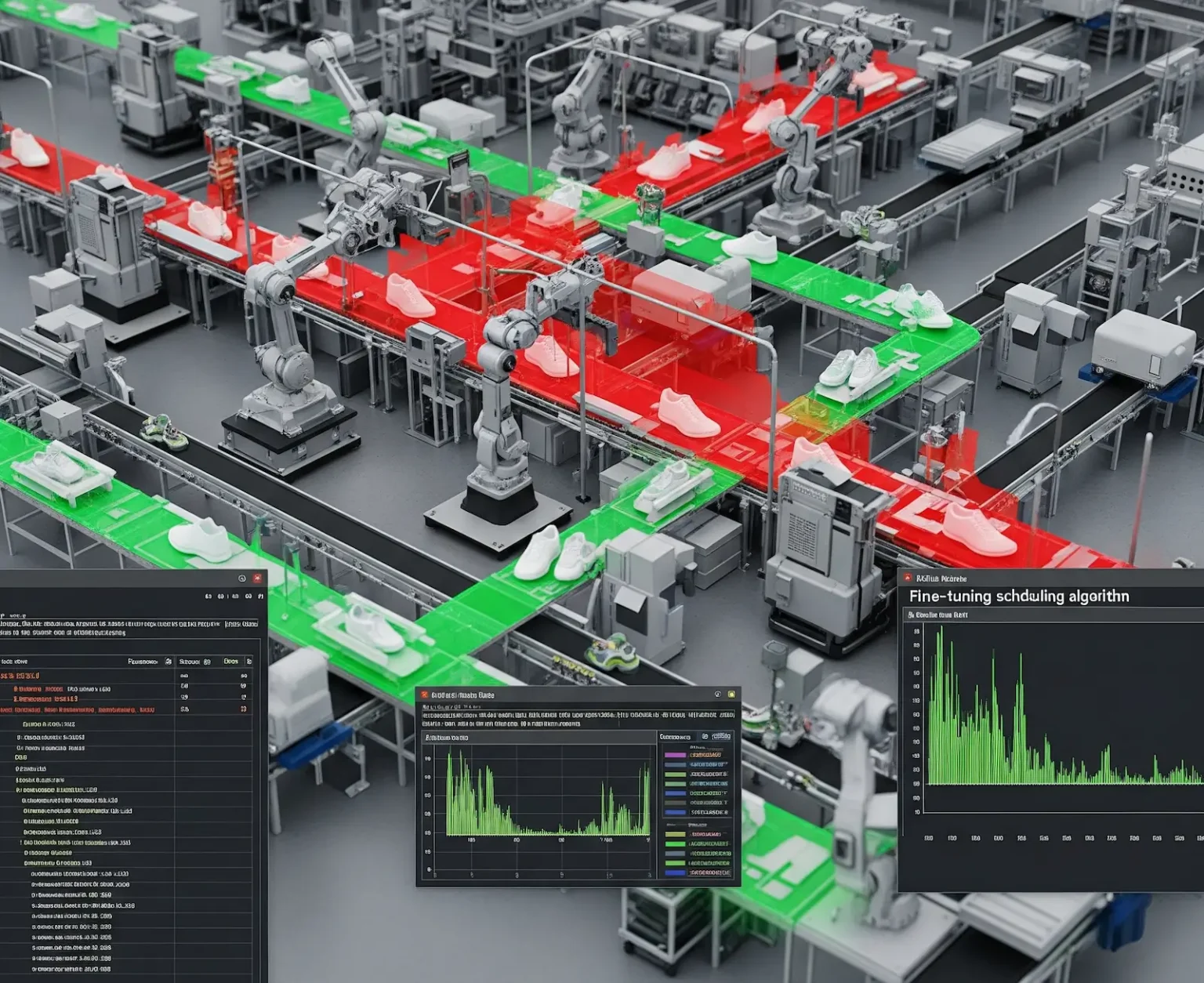
The efficiency of a modern, highly automated, high-tech shoe factory depends to a large extent on precise and optimised schedules. But when planning a factory on a day-to-day basis, it is a major challenge to assess whether a given schedule is feasible and how it will affect the overall production process. The aim of the project was to allow the customer to pre-test different scheduling scenarios with a valid simulation model and refine them based on the results.
Project objective: creation and validation of a detailed simulation model
A prerequisite for successful roadmap testing was a realistic simulation of the factory, which was carried out along the following objectives:
- Detailed mapping of the existing production process with machines, operators, products, recipes and material handling.
- Direct import of production schedules into the simulation model.
- Validate the simulation against real production data.
- Generate a data set, an evaluation that objectively provides feedback on the quality of the schedule.
Solution: accurate and validated simulation model
We have paid particular attention to detail in modelling the factory:
- The modelling used field visits, online consultations and structured data sources to get the most accurate picture of the operation.
- Machinery, logistical processes and recipes are all based on real-life operations.
- The simulation was able to automatically scan the existing schedules and replay the production process according to them.
- During validation, the model outputs were compared with the factory's historical performance data to ensure reliability.
Analysis and results:
Using the validated simulation model, the client:
- It could check whether the schedule could actually meet the desired production targets.
- It could easily identify weak points (e.g. overloaded machines, waiting times, congestion, logistical organisation difficulties).
- Immediate feedback is given if the schedule is delayed.
- Schedules could be quickly compared before actual production execution.
Result: quick and informed decisions
As a result of the project, the client received a realistic, reliable simulation model that can be used to support day-to-day scheduling decisions. The model gave the possibility to fine-tune schedules without taking any real production risk.
Why was this project outstanding?
What made the project unique was that it was possible to simulate not only the production process, but also the production management logic. By being able to automatically scan and run existing schedules, the model provided the client with a dynamic tool that could be integrated into day-to-day operations.
Summary
This simulation project is an excellent example of how discrete event-based simulation can be used not only to investigate system capacity or bottlenecks, but also to support specific day-to-day operational decisions. With such a tool, scheduling is no longer trial and error, but a data-driven, informed decision.
 Hungarian
 English
 German