Goals
- To increase the productivity of the existing End of Line (EOL) robotic production cell, i.e. to reduce the cell cycle time.
- Speeding up the station that constitutes the cell’s bottleneck.
- Improving availability by optimising fault handling and restart processes.
- To increase the flexibility of the robot control system, with particular regard to the ability to control individual stations independently.
Challenges
- The original requirements specified a linear process flow; consequently, the initial robot control system did not need to enable or disable individual stations at will, nor did it need to handle various special operating modes.
- Changing requirements were met by making incremental modifications to the original robot control structure, which resulted in a sub-optimal process and time-consuming troubleshooting.
- The other critical issue was the pneumatic 2D manipulator located at the cell’s bottleneck. The speed at which products were moved limited the total cell cycle time, and adjusting the manipulator was also time-consuming due to the five product types that needed to be handled.
Solution
- During development, the control structure of the PLC robot programme was modified.
- We have replaced the critical manipulation unit with a servo-driven system.
Results
- The cell cycle time has been reduced from 17 seconds per product to 14 seconds per product, thereby significantly increasing output.
- By fitting the pneumatic 2D manipulator with a servo system, the manipulation time was halved.
- Thanks to the updated structure of the PLC robot programme, fault-resolution time has been reduced, resulting in a 5 per cent increase in uptime.
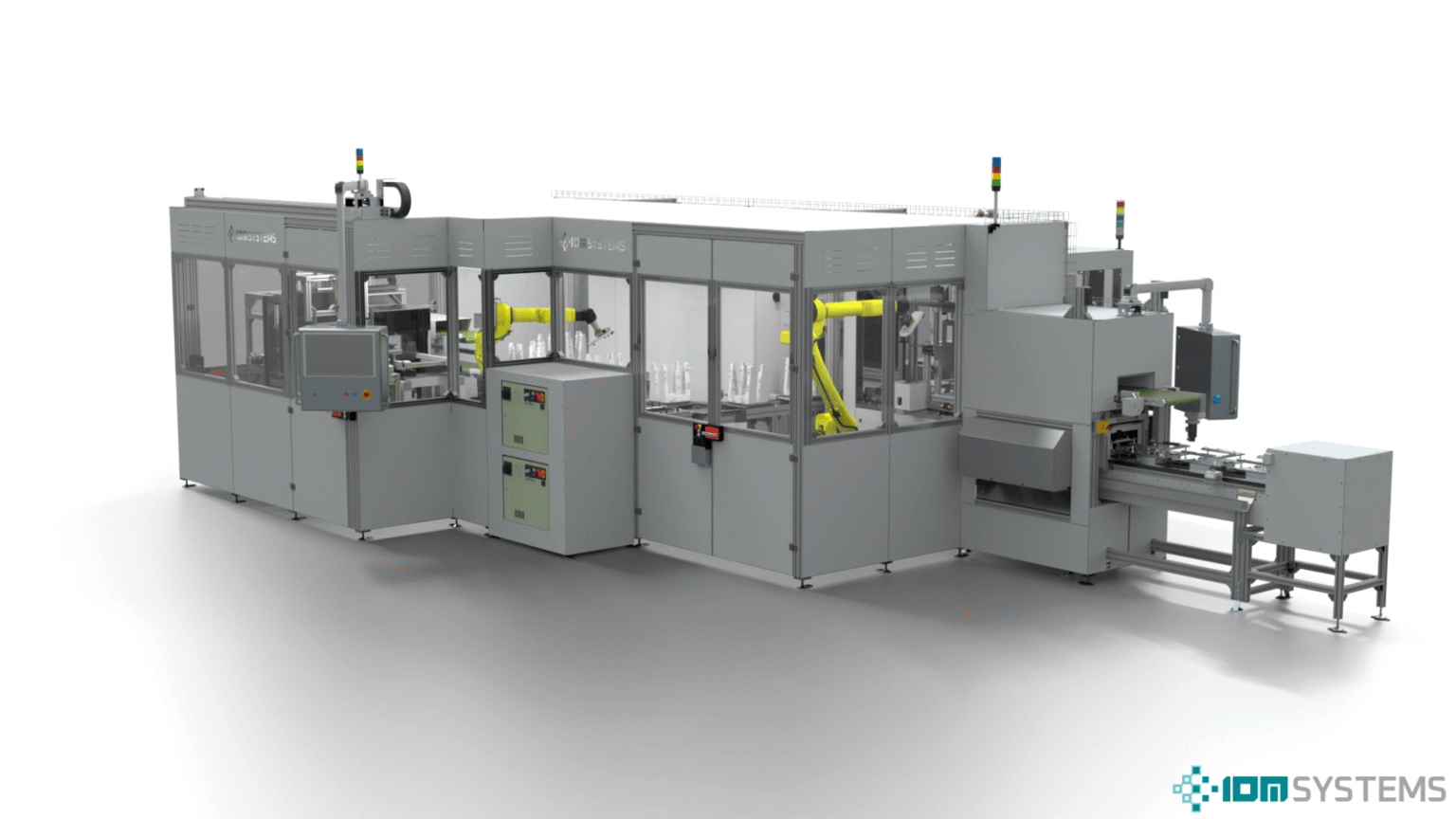
Design of a modular, task- and job-based PLC control system
The original state-machine-style control structure has been replaced by a modular, task–job-based system. Under this new approach, each pick-and-place process is represented as a separate task, within which the pick-up and placement operations function as separate jobs.
The main features of the structure:
- Only one task can be active at any one time.
- Tasks can be sorted by priority.
- The operation of individual robots can be enabled or disabled independently of one another.
- The system also allows for the integration of customised processes – in addition to conventional material-handling operations, the framework supports specialised functions such as camera-based position checking and determination of placement offset, movement to a maintenance position, and automatic homing.
- The new structure can be expanded in a modular fashion and reused in other automation applications.
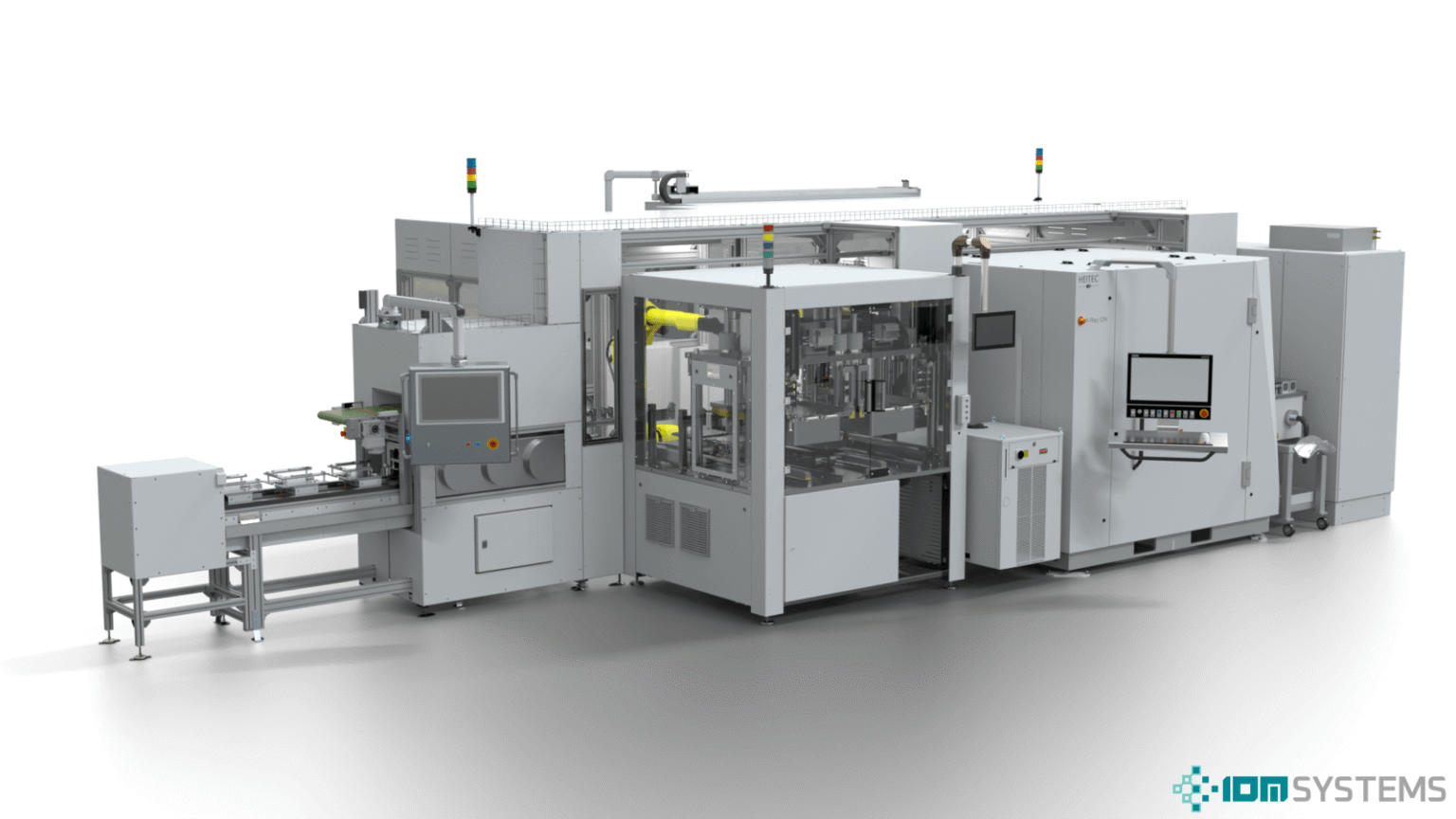
Redesigning the execution structure of robot programmes
In line with the changes made to the PLC, we have also modified the structure of the robot programmes. A separate movement programme has been inserted between each ‘Pick & Place’ sub-programme; this positions the robot between the reference points associated with the pick-up and set-down operations, thereby enabling the robot to follow any desired motion path in order to serve the stations in any order.
One of the most important outcomes of this modification is that robots are now able to come to a halt whilst holding a product in their gripper. In the event of a fault, the cell can therefore enter the STOP state more quickly and in a more controlled manner, as soon as the conditions for a safe shutdown are met.
This significantly improves the fault-handling process, reduces time lost due to downtime and helps to increase availability.
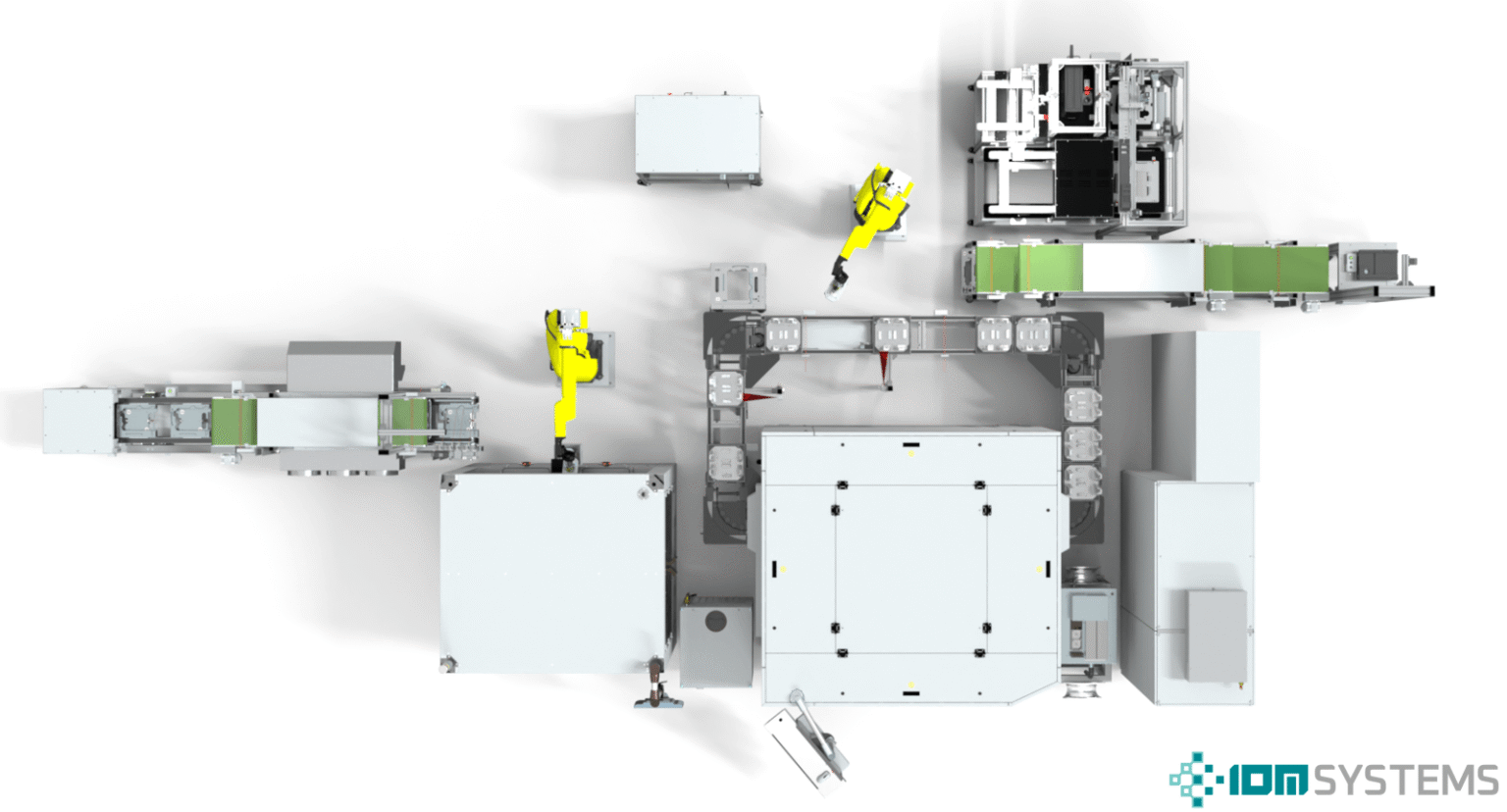
Replacement of a pneumatic manipulator with a servo-driven system
In order to further reduce the cycle time, we replaced the pneumatic 2D manipulator located at the cell’s bottleneck with a servo-driven solution. The servo drive enables faster, more precisely controlled product handling, whilst also simplifying commissioning and maintenance procedures.
As the cell handles five different product types, we have made it possible to configure the manipulator’s movements on a per-product basis: the pick-up and set-down positions, as well as the height of the transfer, can be specified for each product.
As a result of this development – which involved increasing the speed of movement and minimising vertical movements – the handling time was reduced to half its previous value. This not only accelerated the critical product-handling process, but also contributed to reducing the cycle time of the entire production cell.
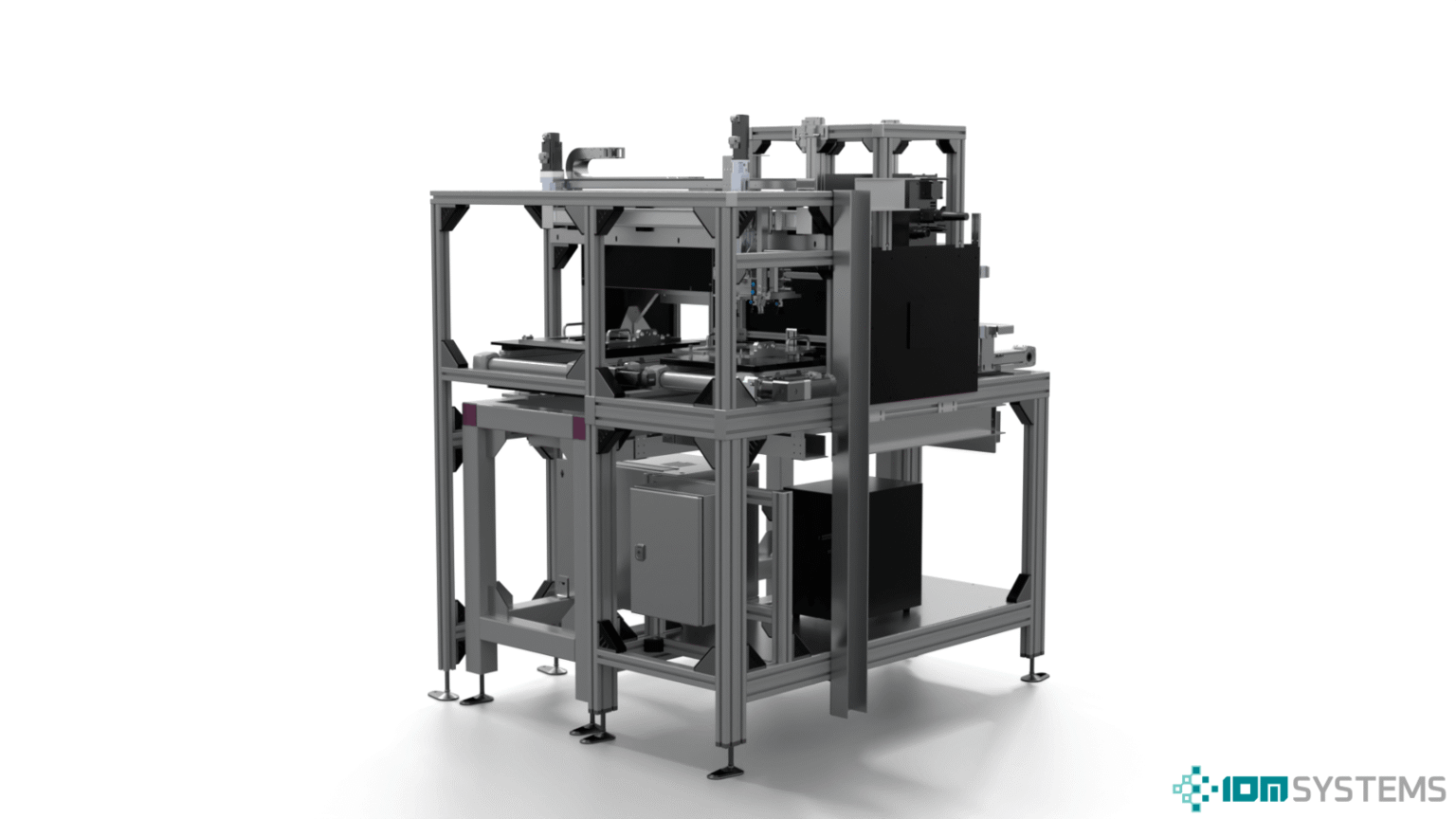
The redesign of the control structure and the modernisation of the handling system together resulted in a significant increase in performance.
Key achievements
We ran multiple scenarios. Examples:
| KPI | Previously | Following development | Degree of change |
| Cycle time | 17 seconds per item | 14 seconds per piece | -17,6% |
| Handling time (2D manip) | 100% | 50% | -50% |
| Availability | 85% | 90%+ | +5% |
| Nominal productivity | 211.8 units per hour | 257.1 pcs/h | +21,4% |
| Effective productivity | 180 pieces per hour | 231.4 pcs/h | +28,6% |
Business impact
Based on an assumed product value of 100 EUR per unit, the cell’s theoretical effective output under the previous operating conditions was 180 units per hour, which corresponds to a product value of 18,000 EUR per hour.
Following the development, based on a cycle time of 14 seconds and 90 per cent availability, the effective output rose to 231.4 units per hour.
This enables the production of approximately 51 additional products per hour, which represents an additional product value of approximately 5,142 EUR per hour, assuming theoretical capacity utilisation. Assuming continuous production for 6 days a week, this could represent an additional product value of 0.74 million EUR compared with previous operations. Assuming 48 effective production weeks per year (2 x 2-week shutdowns) and continuous operation six days a week, the increase may indicate in capacity up to EUR 35.5 million in additional product value on an annual basis along theoretical capacity utilisation.
Reusable development outcome
The success of the project is not only demonstrated by measurable performance indicators. We have also successfully implemented the further-developed, modular robot control structure in the EOL cell that was previously handed over. There, too, productivity indicators have improved significantly, exceeding the client’s expectations.
This demonstrates the reusability and scalability of the new control concept: the development has not only improved the performance of a single production cell, but also establishes a stable technical foundation that can be further developed for future automation projects.
 Hungarian
 English
 German